
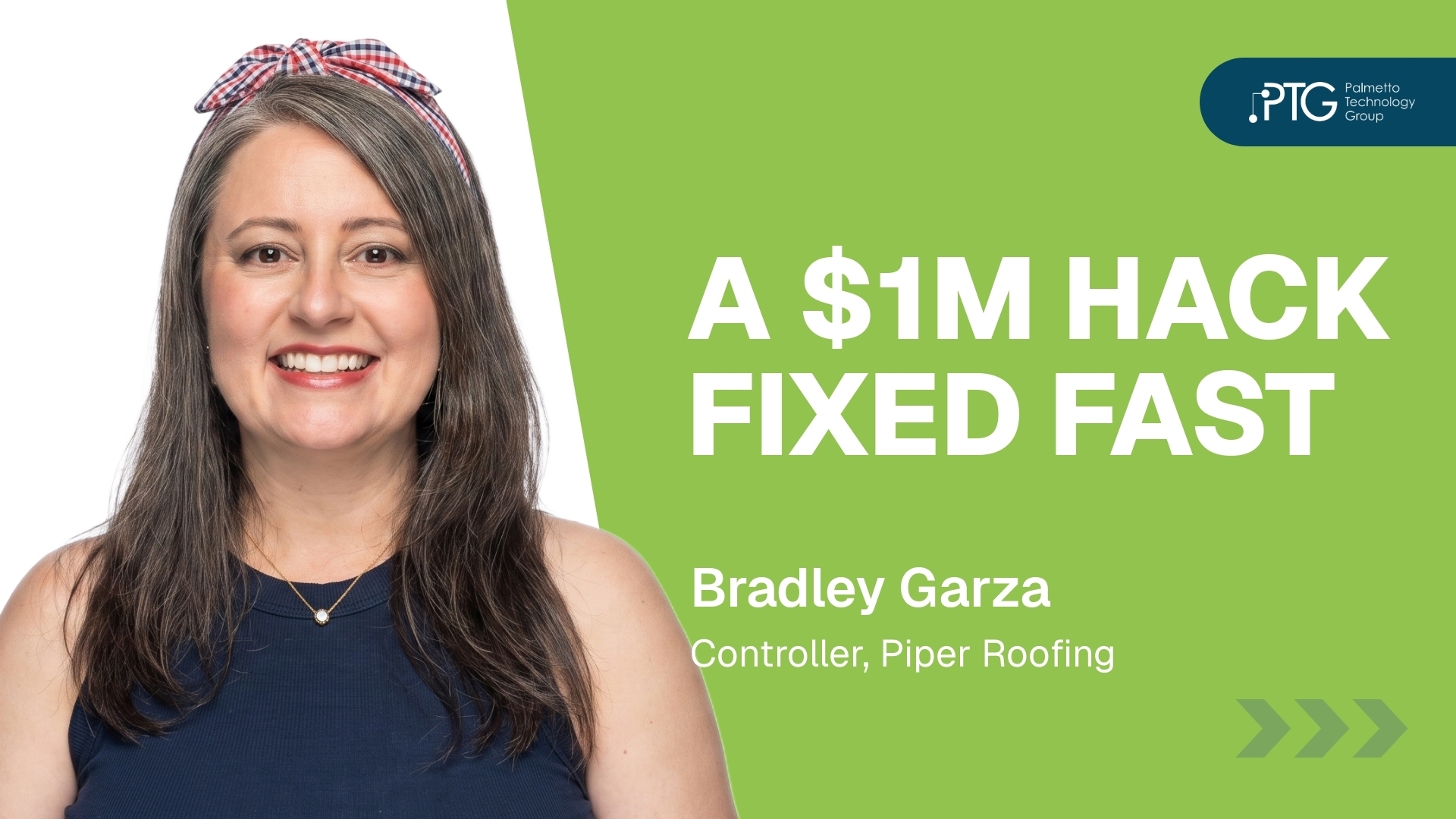
By Linda Mayes, Regional President, Palmetto Technology Group
Most businesses assume a cyber attack is something that happens to someone else, a bigger company, a flashier target, a careless team. Piper Roofing assumed the same thing, right up until hackers locked their server and demanded a million dollars. They are a fourth-generation commercial roofing company that has covered the Upstate of South Carolina since 1908, the steadiest kind of business you can imagine. This is the story of what the attack cost them, why their old IT setup left them exposed, and what changed when they moved to PTG.
A Heritage Business with a Modern Problem
Piper Roofing has roofed Greenville landmarks for well over a century, from the Poinsett Hotel to the Greenville County Courthouse. Around 60 employees, all in-house, no subcontractors, with a service and preventative-maintenance approach built to make roofs last. For all that care over the physical work, the technology underneath the business was resting on a single person. Their IT provider was knowledgeable, but he was one man with a lot of pulls on his time. When something broke, it could sit for two or three days, and equipment quietly aged past the point of being safe.
The Attack That Opened Their Eyes
Then the worst happened. Hackers got into Piper’s server, locked all of their information with ransomware, and demanded a ransom of a million dollars. The company shut everything down, spent thousands on recovery, and managed to claw most of their data back. Not all of it. As controller Bradley Garza puts it: “We were missing about two years of important financial information, things that you can’t replace.” Recovery took roughly nine months, and Bradley spent much of it recreating spreadsheets by hand.
Why One Person Is a Single Point of Failure
Beyond the immediate damage, the breach made a quieter and more structural risk impossible to ignore any longer. “We had a single provider essentially. He was a one-man show,” Bradley says. He was good at his job, but there was no cover behind him, and no one focused on keeping equipment and software current. “If something happened to him, we wouldn’t have anyone to take care of us.” For a growing company, betting everything on one person’s availability is a risk that only shows itself at the worst possible moment.
Finding a Real Team in PTG
A Piper employee, Dan, had a connection with Joseph at PTG, and a conversation led to a proposal Piper liked. “We liked that they’re a larger company that can manage things. We liked that they keep up with technology and the cutting edge things.” Switching was not effortless, and Bradley is honest about that: “It was definitely a bumpy start, but that was to be expected. But it’s turned out to be a huge blessing for us.” PTG rebuilt the hardware, improved the network throughout the building, and put cloud backups in place so the data no longer lived in one fragile spot.
Hours, Not Days
The difference shows up where Bradley feels it most, in how fast things get fixed. “It’s taken care of in a matter of hours versus days,” she says. Under the old setup, a downed workstation could stall someone’s work for two or three days. Now most issues are handled same day. There is a whole team behind Piper, sharing notes so nobody starts from scratch, plus a named account manager who runs reviews that lay out exactly what hardware is current and what is due next, so the company can budget ahead.
Peace of Mind, and a Clear Recommendation
After what they lived through, the change Bradley values most is simple. “I feel so much better. I know our hardware is up to date. I know that our software is up to date.” The cloud backups, in particular, mean the ransomware nightmare cannot repeat itself the same way. Asked what she would tell another business, she does not hedge: “I would absolutely recommend PTG.” And the line that says it all: “If PTG disappeared tomorrow, we would be in trouble.”
Key Takeaways
- No business is too steady or too ordinary to be a ransomware target.
- Backups are the difference between a scare and a permanent loss. Piper recovered most of their data, but about two years of financial records could not be replaced.
- Running IT on a single person is a single point of failure, exposed at the worst possible time.
- The value of a good IT partner shows up in fix times: hours, not days.
- A planned hardware refresh you can budget for keeps small gaps from becoming big risks.
Frequently Asked Questions
What happened to Piper Roofing?
A ransomware attack hit their server with a million-dollar ransom demand. They recovered most of their data, but about two years of financial records were lost for good, and it took roughly nine months to fully recover.
Why was their old IT setup a risk?
Their IT rested on a single provider. He was knowledgeable but stretched thin, fixes took two to three days, equipment aged, and there was no cover if anything happened to him.
What did PTG change?
PTG put a whole team behind Piper, rebuilt the hardware and network, added cloud backups, and set up a planned, budgeted hardware refresh. IT issues now get fixed in hours instead of days.
How fast does PTG resolve IT issues now?
Most issues are handled same day, or next day at worst depending on severity, compared with the two to three days it used to take.
Would Bradley Garza recommend PTG?
Yes. In her words, she would absolutely recommend PTG, and she says if PTG disappeared tomorrow, the company would be in trouble.
Who is PTG and where do they work?
PTG (Palmetto Technology Group) is a managed IT services provider supporting businesses across the Upstate of South Carolina and Western North Carolina.
Is your IT resting on one person?
If a single person holds your whole IT setup, you have the same gap Piper did. Watch Bradley Garza tell it in her own words — the attack, the nine-month recovery, and what changed when a whole team took over their IT. Let’s talk about what that would look like for you.